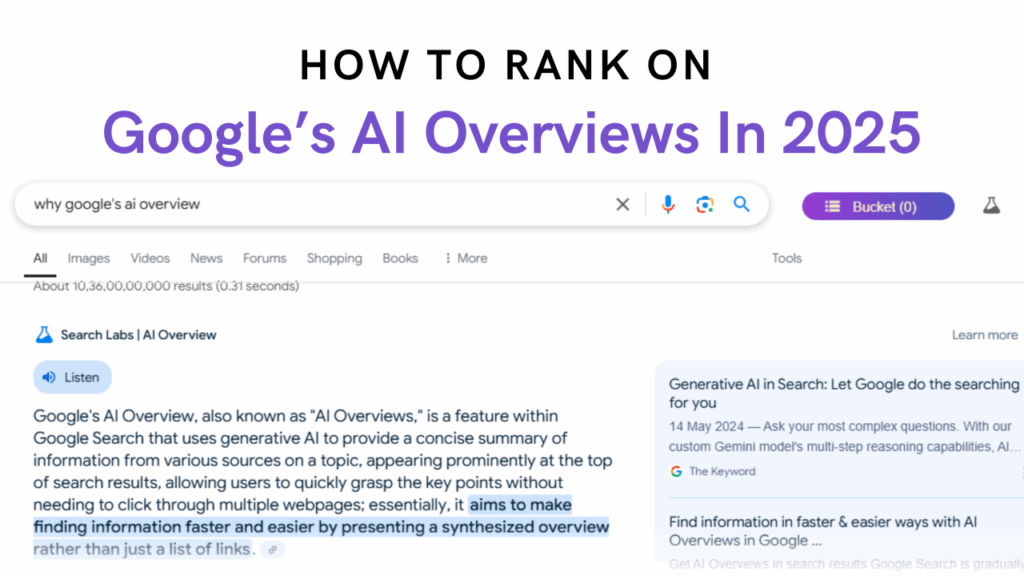
How to Rank in Google’s AI Overviews in 2025
The SEO landscape has evolved dramatically in recent years, and Google AI Overviews—formerly known as Search Generative Experience (SGE) – are now at the forefront of this change. These AI powered snapshots sit prominently at the top of Google search results, providing users with concise, AI generated answers sourced from multiple web pages.
For marketers, bloggers, and businesses alike, this evolution presents both challenges and opportunities. So, how do you ensure your content is visible, cited, or even featured in these AI overviews? Let’s dive into the essential strategies for optimizing your SEO in 2025 for Google AI Overviews.
📌 TL;DR – Quick Optimization Checklist:
✅ Use clear, direct language.
✅ Target conversational queries.
✅ Add schema markup.
✅ Keep content updated.
✅ Build trust with E-E-A-T.
✅ Write quotable content.
✅ Focus on mobile and voice search.
✅ Monitor your content’s AI mentions.
✅ What Are Google AI Overviews?
Google AI Overviews are AI-generated summaries shown at the top of many search result pages. Instead of listing links alone, Google now uses artificial intelligence to pull information from various sources and answer user queries directly within the search interface.
These AI Overviews:
- Pull from high-quality, authoritative content.
- Emphasize trustworthiness and clarity.
- Often feature citations linking back to the original sources.
🎯 Why Do AI Overviews Matter for SEO?
- Top Placement: AI Overviews often appear above all other results, including ads.
- Increased Visibility: If your content is cited in an overview, it gains major visibility and authority.
- New User Behavior: Users are increasingly scanning AI-generated answers instead of clicking traditional links.
🔍 How to Optimize for Google AI Overviews
1. Write with Clarity and Authority
Google’s AI prefers content that is clear, direct, and authoritative.
Tips:
- Use simple, jargon-free language.
- Answer questions directly at the beginning of your content.
- Structure content using headings (H2, H3) to guide the AI.
Example: Instead of writing “There are many ways to bake a cake,” say “To bake a cake, first preheat the oven to 350°F.”
2. Target Long-Tail, Conversational Queries
Google AI understands and favors natural language questions.
Action Steps:
- Use tools like AnswerThePublic or Google’s “People Also Ask” to find real user questions.
- Create FAQ sections targeting these queries.
- Optimize blog titles and headers using natural, question-based phrasing.
3. Use Schema Markup and Structured Data
Schema helps Google’s AI understand your content contextually.
Best Practices:
- Implement FAQ, How-To, Article, and Product schema wherever applicable.
- Use structured data to highlight prices, reviews, authorship, and more.
4. Keep Content Fresh and Updated
Google AI values timely and up-to-date content for generating overviews.
Checklist:
- Regularly update blog posts with the latest stats, news, or features.
- Add “Last Updated” dates to improve trust signals.
- Refresh internal links to ensure accuracy.
5. E-A-T Becomes E-E-A-T
The updated Google ranking criteria now emphasize:
- Experience
- Expertise
- Authoritativeness
- Trustworthiness
How to Apply:
- Highlight real-world experience (e.g., “Written by a certified nutritionist”).
- Include author bios with credentials.
- Link to reputable sources and studies.
6. Get Cited, Not Just Clicked
Your content doesn’t need to rank #1—it needs to be good enough to be cited.
Focus Areas:
- Write quotable definitions, steps, or stats.
- Use bullet points, numbered lists, and direct quotes.
- Build backlinks from reputable sites to increase domain authority.
7. Optimize for Mobile and Voice Search
AI Overviews are influenced by mobile and voice search queries.
Tips:
- Use mobile-friendly design and fast-loading pages.
- Answer questions users might ask with voice assistants.
- Use conversational, natural language.
8. Track AI Overview Appearances
Use tools like:
- Google Search Console (Performance > Search Appearance)
- SEO platforms like Semrush or Ahrefs (tracking AI snippet mentions)
Stay informed on whether your content is being cited in AI summaries.
🚀 Final Thoughts
Google AI Overviews are reshaping how people interact with search engines—and how we approach SEO. By focusing on clarity, credibility, structure, and user-centric writing, you can position your content to be featured in AI-generated summaries.
In 2025 and beyond, SEO isn’t just about rankings—it’s about relevance, trust, and usefulness to AI.
Need help optimizing your site with breadcrumbs and other SEO elements?
Contact our SEO expert in India today and take the next step in enhancing your digital presence.